The idea
Stock research can involve separate views for price movement, company news, technical signals, and a personal watchlist. This project brings those pieces into one workspace and makes the reasoning behind a signal visible.
Stock AI MVP is my personal market-research application. Its current recommendation engine is rules-based. The project also contains an explanation-service boundary and agent/tool contracts; those are separate from a fully autonomous investing system.
The workflow
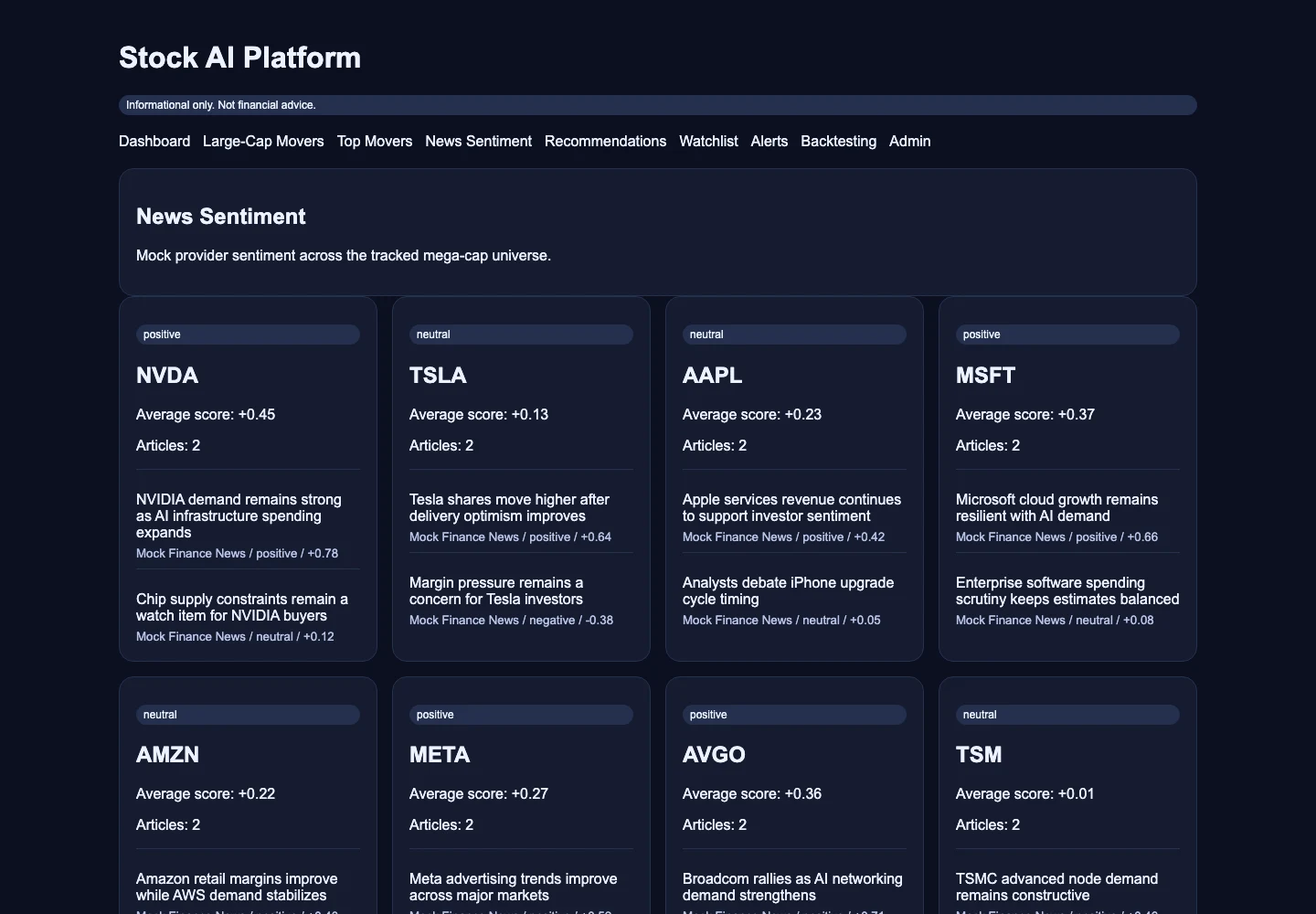
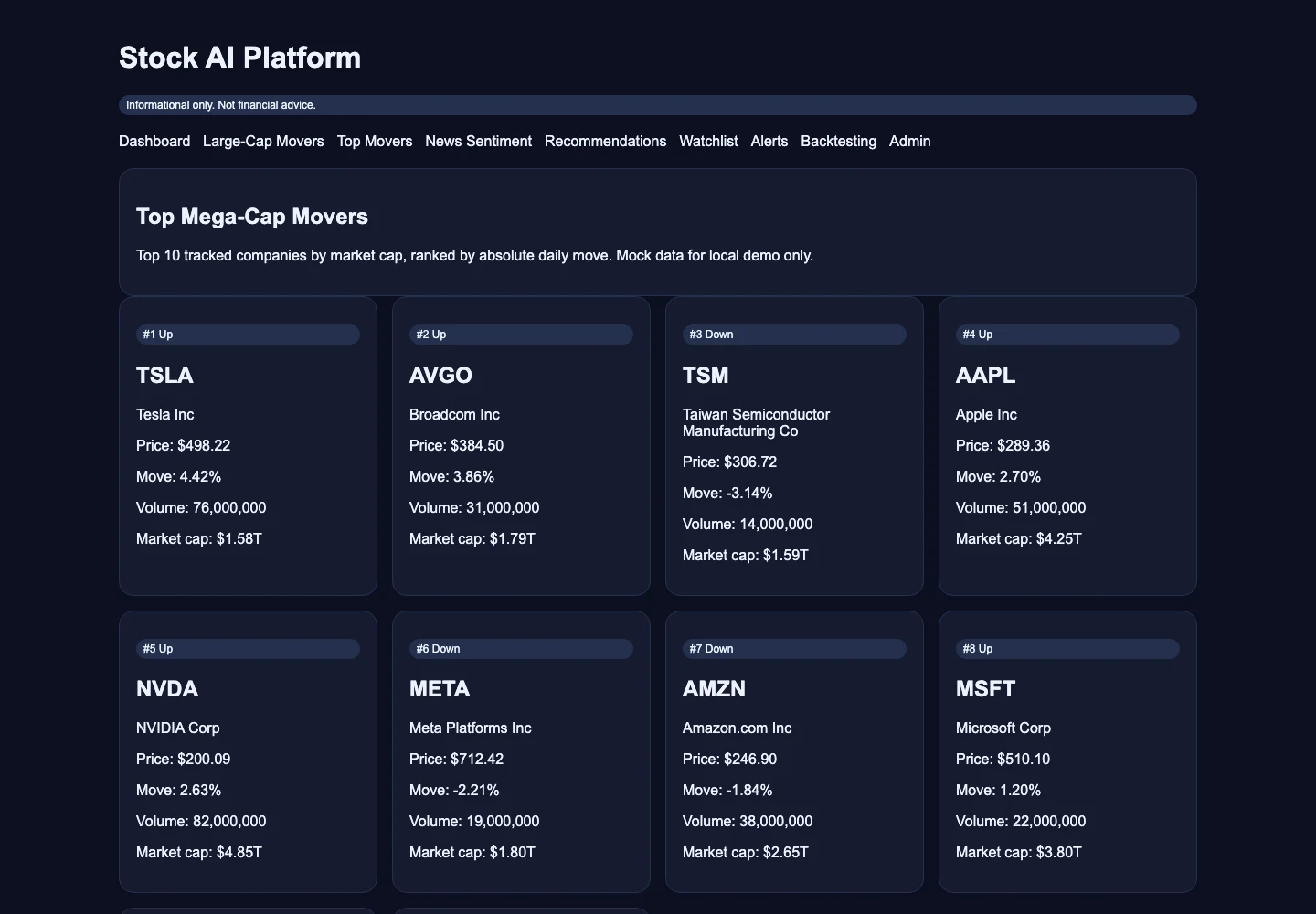
The interface includes market overview, large-cap movers, top movers, news sentiment, recommendations, watchlists, alerts, and strategy backtesting. The captured screens show the local mock-provider demo, including its on-screen mock-data labels.
A visitor can understand the workflow without treating the displayed prices, headlines, or sentiment values as live information. The portfolio does not run an investment service or connect to a brokerage.
Behind the build
A Next.js and TypeScript frontend consumes a FastAPI backend. Provider interfaces separate market and news data from the application features. Mock implementations make the local demo usable without a paid data subscription; a Polygon adapter adds provider-specific requests, bounded retries, timeouts, and caching.
PostgreSQL stores application records such as recommendations and watchlists. Redis supports the provider cache. Standardized API errors and request identifiers give the frontend a way to explain provider failures instead of silently presenting missing data as a valid result.
Engineering decisions
Signals remain inspectable. The implemented rules combine momentum, volume, trend indicators, RSI, market capitalization, sentiment, and volatility. The code returns supporting signals with its output. This is an explainable scoring mechanism, not evidence of predictive accuracy.
External providers sit behind a boundary. The UI and domain services can use mock data locally while keeping a separate integration path for provider data. Provider availability and subscription limits remain real constraints.
Backtesting has explicit assumptions. The current moving-average strategy uses deterministic next-candle execution and transaction fees. Slippage, corporate actions, taxes, parameter sweeps, and persisted run comparisons are outside that version’s documented scope.
Current state and next steps
The repository contains the local full-stack demo, provider adapters, persistence, user-scoped application features, and operational scaffolding. The recommendation rules and backtest implementation are present in source; their investment performance is not established by this case study.
Further work includes persisted backtest runs and walk-forward datasets, production identity-provider provisioning, and scheduled alert evaluation and delivery. Infrastructure manifests are deployment scaffolding, not a claim that this application is hosted in production.
The screenshots contain mock market and news data. This project is informational software and does not provide financial advice.